The Senate Moves to Limit Trump on Venezuela
Five Republican senators joined with Democrats to rebuff the White House and move ahead with a resolution to require Congress to approve any further use of military force against Venezuela.
By experts and staff
- Published
Experts
![]() By James M. LindsayMary and David Boies Distinguished Senior Fellow in U.S. Foreign Policy
By James M. LindsayMary and David Boies Distinguished Senior Fellow in U.S. Foreign Policy

As Benjamin Franklin left the concluding session of the Constitutional Convention in September 1787, an onlooker asked whether he and his fellow delegates had created a republic or a monarchy. Franklin answered: “A republic, if you can keep it.” Franklin’s question has taken on a new relevance over the past year with President Donald Trump acting as if the only limit on his authority to act abroad is his “personal morality” and with the Republican Congress seemingly following his lead in lockstep. By any objective measure, Trump has moved in his second term in office to create a true imperial presidency.
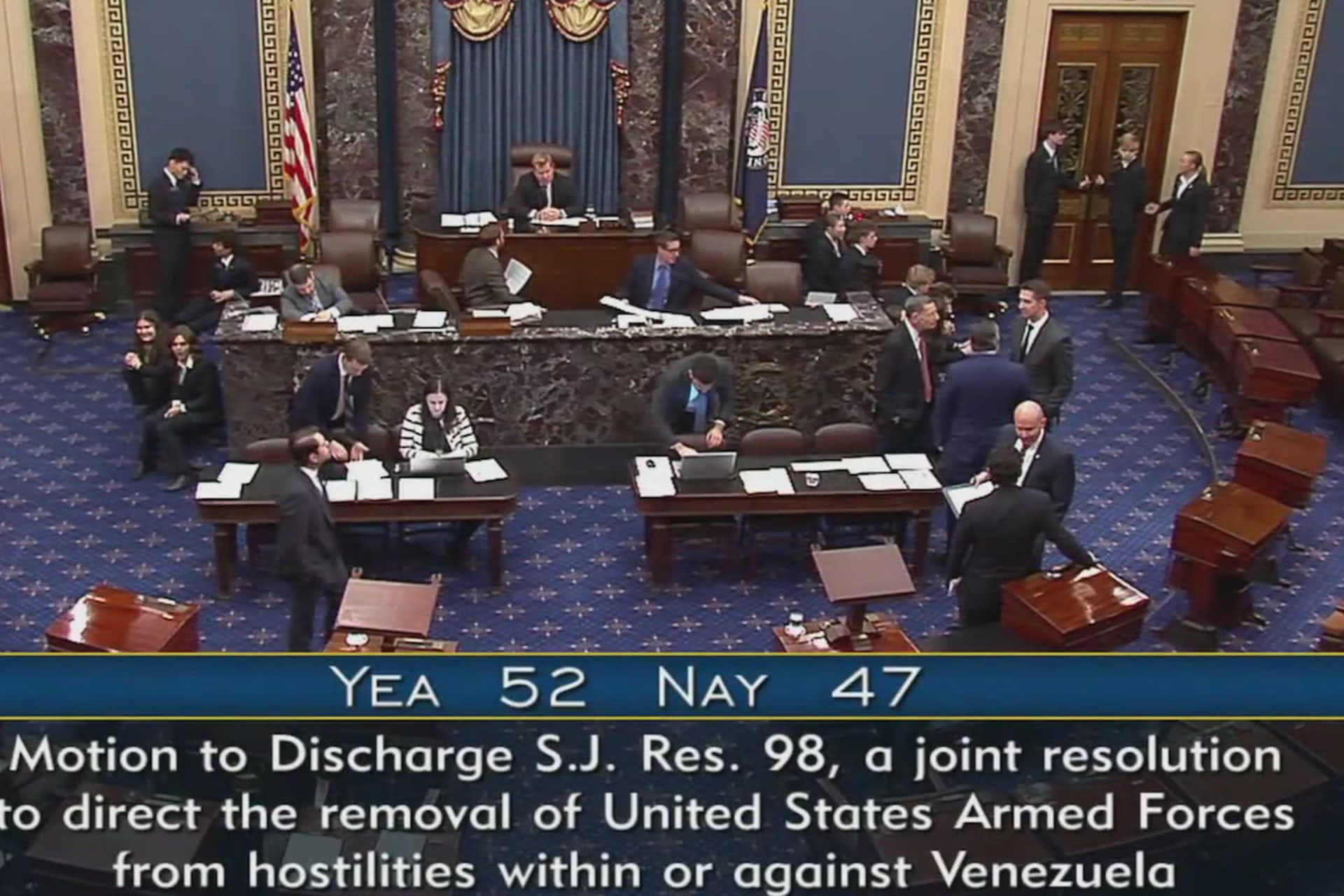
In that context, yesterday’s 52 to 47 Senate vote to invoke a provision of the 1973 War Powers Resolution to force a vote on requiring Congress to authorize any further military action against Venezuela is notable. The Senate action was an instance, rare over the last year, of Capitol Hill pushing back against Trump. The question now is whether the rebuff is a one off or the beginning of a shift back toward a more contested, and more typical, relationship between Congress and the White House.
The significance of yesterday’s vote should not be overstated. The Senate did not limit Trump’s freedom of action in any way. The vote was purely procedural: it authorized another vote, likely next week, on a measure co sponsored by Sen. Tim Kaine (D-Va.) and Sen. Rand Paul (R-Ky.) that would require Trump to come to Congress before using military force in Venezuela again. Moreover, the Senate action came a day after Trump withdrew the United States from sixty-six multinational organizations with few protests from Senate Republicans, even though the president’s authority to unilaterally terminate treaties remains disputed. At the same time, the House of Representatives turned back two efforts yesterday to overturn Trump’s vetoes of domestic policy bills, with many Republican lawmakers switching positions to support the president.
Nonetheless, the Senate’s decision to invoke the provisions of the War Powers Resolution was noteworthy because senators knew that the vote would be seen rebuking Trump. In all, five Republicans broke ranks: Susan Collins of Maine, Josh Hawley of Missouri, Lisa Murkowski of Alaska, Rand Paul of Kentucky, and Todd Young of Indiana. They were joined by every Democratic and Independent senator. Just two months ago, only Murkowski and Paul voted to require Trump to obtain congressional approval before taking military action against Venezuela.
As usual, Trump did not take kindly to being defied. He immediately lit into the Republican defectors on Truth Social, saying they “should never be elected to office again.”
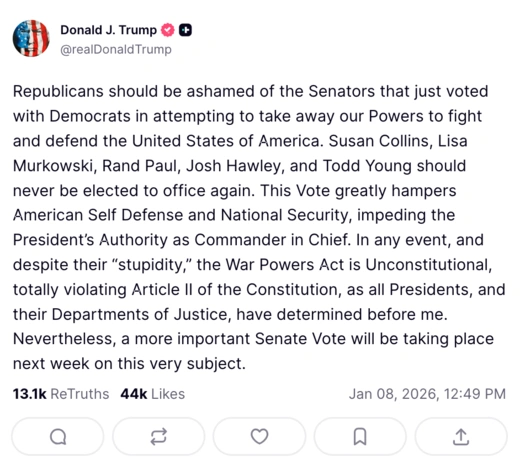
The post no doubt made Republican political strategists wince. Collins is the only one of the five up for reelection this November. She is also the only incumbent Republican senator running for reelection in November who represents a state that went for Kamala Harris in 2024. Democratic hopes for retaking the Senate hinge on taking her seat.
Electoral politics aside, yesterday’s vote by no means guarantees that the Senate will pass the Kaine-Paul measure. Some of the Republican defectors may be content with having forced a vote and reaffirming the principle that Congress has the ultimate say on matters of war and peace. They may point to Trump’s statement this morning that he has “cancelled the previously expected second Wave of Attacks” and argue that the vote is now moot. Or Trump may succeed in pressing them to change their minds, as he seemingly did yesterday with many House Republicans.
Even if the Kaine-Paul measure passes the Senate, its chances of becoming law remain close to nil. First, the House would need to pass it as well. That is unlikely, but not impossible. The House narrowly rejected two similar resolutions last month on virtually straight party lines. The resignation this week of Rep. Marjorie Taylor-Greene (R-Ga.) and the death Rep. Doug LaMalfa (R-Calif.) have shrunk the already small Republican House majority. Speaker of the House Mike Johnson (R-La.) now can lose only two votes and still keep his majority. But again, Trump has shown a remarkable ability to whip Republican House members in line.
Second, and most relevant, Trump would veto the measure if it made its way to his desk. As yesterday’s House votes indicate, it is unlikely that Congress would override that veto.
What yesterday’s Senate vote, and Operation Absolute Resolve more broadly, illustrate are the practical challenges that Congress faces in asserting its constitutional war powers. As Alexander Hamilton observed in Federalist No. 70, the president has the advantage of “decision, activity, secrecy, and dispatch” over the other end of Pennsylvania Avenue. That reality applies even more so today given the speed with which military forces can be dispatched. Simply put, presidents can act and dare Congress to defy them. Lawmakers cannot count on the courts, which have generally refrained from policing the boundaries of the separation of powers when it comes national security, to bail them out. Congress can block or reverse a president only if it acts with sufficient speed and unity to pass legislation that can withstand a veto. That is a tall mountain to climb given understandable differences over what constitutes the right policy and the inevitable partisan pressures that infuse everything that happens on Capitol Hill.
A system in which one person can authorize the U.S. military to engage in acts of war is not what the founders had in mind. Their expectation, however, rested on the assumption that presidents would view their foreign affairs powers narrowly. That assumption was tested almost immediately as theory met reality in the early years of the Republic, though it largely held into the twentieth century. Since the end of World War II, however, presidents have embraced an increasingly expansive view of what they can do abroad on their own authority, a view aided by generous grants of statutory authority by Congress. The question now is how members of Congress will respond to the challenge of a president who says that the only limit on what he can do is his own morality.
Oscar Berry assisted in the preparation of this post.